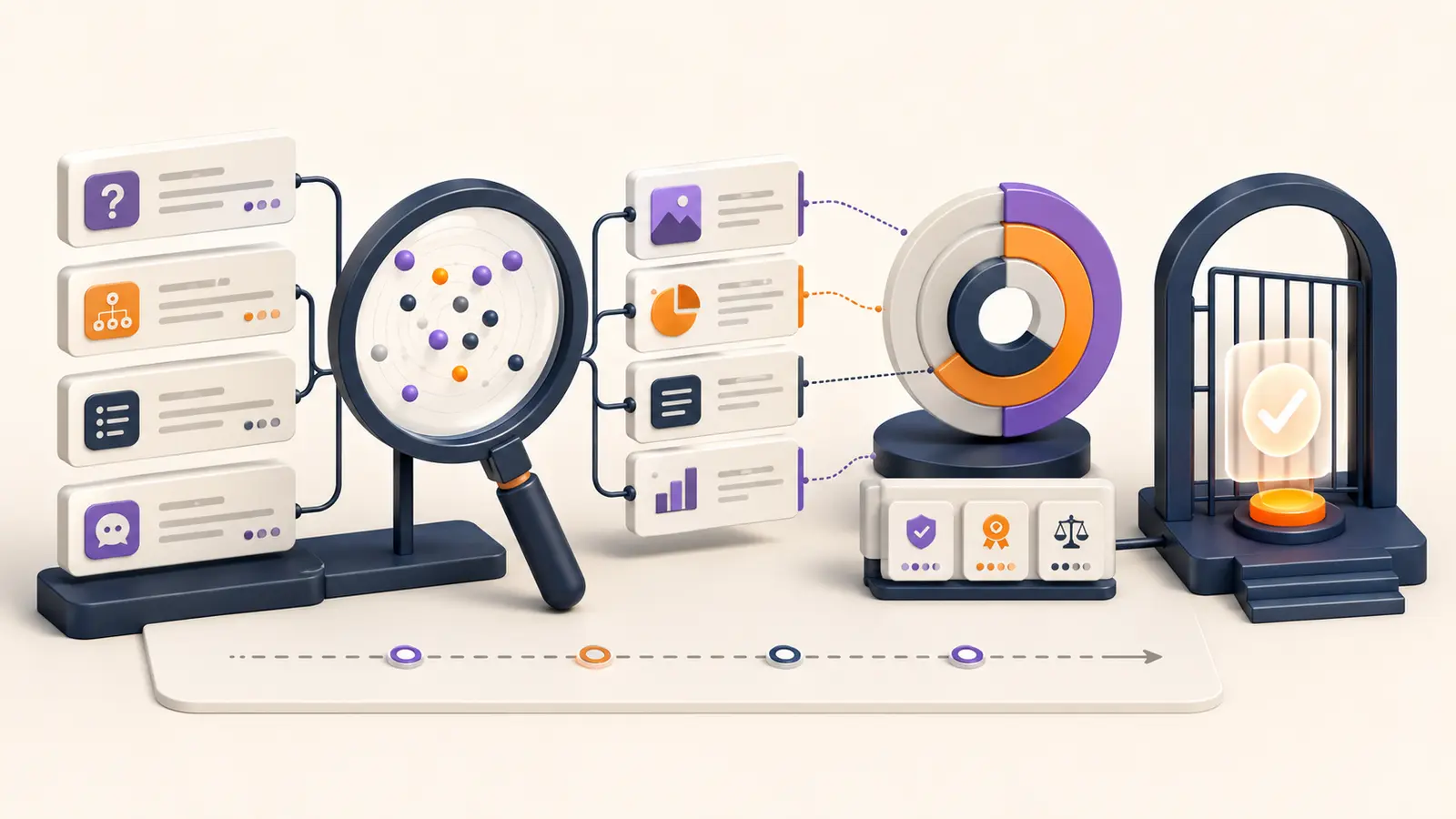
The architecture and operating practices that keep enterprise assistants useful after launch.
Grounding is a system property
A grounded answer is not created by a prompt alone. It depends on source ownership, ingestion, parsing, indexing, retrieval, permissions, generation and the user experience that shows evidence. If any layer is weak, the final answer can sound confident while being incomplete or wrong. Treat the knowledge system as a product with an operating model, not a search box attached to a model.
Define the source of truth
Start by listing document families, owners, update processes and retention rules. Resolve duplicate versions and decide how superseded content is marked. A source catalogue gives users and engineers a shared vocabulary for why a document is included, excluded or prioritised. It also makes incident investigation possible when a user reports that an answer used the wrong policy.
Parse for meaning, not only text
Enterprise files contain headings, tables, footnotes, scanned pages and metadata that affect interpretation. Extraction should preserve structure where the workflow needs it. Add document identifiers, effective dates, department, confidentiality and version metadata. Chunking should follow meaningful boundaries and keep enough surrounding context for the question being asked.
Retrieve with layered signals
Vector similarity is useful but rarely sufficient on its own. Combine semantic retrieval with keyword, metadata and permission filters. Rerank a manageable candidate set and remove duplicate or contradictory passages. Measure recall on known questions before tuning the generation prompt. If the right evidence is not present, a more capable model will only produce a more persuasive guess.
Make evidence visible
Users should be able to see which sources support an answer and open the relevant passage. Show when the system could not find enough evidence and provide a safe next action. Citation design is not decoration; it changes whether people can verify, correct and trust the result. Capture the evidence used for each response so support teams can reproduce a case.
Design permission boundaries
Apply access controls before retrieval results are placed in the model context. Use the identity and permissions of the requesting user, not a broad service account alone. Test cross team leakage, deleted documents, inherited permissions and cached results. Document the behaviour for restricted questions so users understand why an answer may be limited.
Operate the knowledge base
Assign owners for ingestion failures, source review, evaluation sets and user feedback. Monitor freshness, parsing errors, retrieval quality, latency and cost. Establish a release process for chunking, embedding, reranking and prompt changes. A quarterly review of high value sources and failed questions is often more valuable than adding another model.
A groundedness checklist
A durable knowledge system has named sources, meaningful metadata, permission aware retrieval, representative evaluation, visible citations, uncertainty handling and a feedback loop. It also has a clear rule for when the system should stop and ask a person. These controls make the assistant useful in daily work instead of impressive only in a demonstration.
Questions to carry into delivery
A useful workshop starts by asking what people do today when the information is incomplete. Listen for spreadsheets, side conversations, copied answers and manual checks because these reveal the hidden operating cost. They also show where a proposed system must fit. Capture the language users already use, the decisions they are allowed to make and the evidence they need to defend those decisions. This prevents an attractive technical design from solving a problem that the team does not actually experience. This principle is especially important when applying the rag & knowledge systems lens to a live business workflow.
The first release should have a deliberately narrow promise. Define the supported input, the supported output and the situations that will be handed back to a person. Narrow scope is not a weakness; it creates an evaluation boundary and makes adoption easier. A team can expand after it understands failure patterns, source quality and the cost of review. Trying to support every department and every document family at once usually hides uncertainty until the most expensive stage of delivery. This principle is especially important when applying the rag & knowledge systems lens to a live business workflow.
Architecture choices should be explained in terms of the workflow. A queue, API, retrieval index, model provider or approval screen is useful only when it changes reliability, speed, quality or ownership. Document the reason for each boundary and the failure behaviour when it is unavailable. This makes the design easier for product, security and operations stakeholders to challenge. It also gives future engineers a way to change one component without accidentally changing the business contract. This principle is especially important when applying the rag & knowledge systems lens to a live business workflow.
A good test set is a living representation of the work. Start with normal cases, then add examples that expose ambiguity, missing context, contradictory sources, unusual formatting and a request the system must refuse. Label the expected action and the evidence that supports it. Invite subject matter experts to review a sample and explain disagreements. Their explanations are often more valuable than a single score because they reveal policy gaps and opportunities to simplify the workflow. This principle is especially important when applying the rag & knowledge systems lens to a live business workflow.
Do not treat feedback as a generic thumbs up signal. Ask what was wrong: missing evidence, incorrect interpretation, incomplete answer, poor formatting, stale source, unsafe action or unnecessary effort. Map each label to an owner and a possible fix. Retrieval issues may need better metadata; behaviour issues may need prompt or model changes; process issues may need a new approval step. Specific feedback turns a queue of complaints into an improvement plan. This principle is especially important when applying the rag & knowledge systems lens to a live business workflow.
Security and privacy decisions should be made before data is connected. List the identities that can request, retrieve, approve and change information. Decide what is masked, logged, retained and deleted. Test the negative path: a user with partial access, a stale permission, a malicious document or a request that asks for hidden instructions. These tests create confidence that the system behaves responsibly when real conditions are less tidy than the prototype. This principle is especially important when applying the rag & knowledge systems lens to a live business workflow.
Adoption improves when the system explains its role. Tell users whether the result is a draft, recommendation, classification or action proposal. Show the supporting evidence and make corrections easy. Make the next step obvious and keep existing operational ownership visible. When people understand what the system can and cannot do, they are more likely to use it carefully and report the cases that deserve engineering attention. This principle is especially important when applying the rag & knowledge systems lens to a live business workflow.
At the end of a delivery phase, write down the decision the evidence supports. It may be to expand the workflow, improve the data, change the model, keep a human review boundary or stop the experiment. A clear stop decision is valuable because it prevents sunk cost reasoning. A clear expansion decision is valuable because it gives the next team a scope, measure and owner instead of another open ended AI ambition. This principle is especially important when applying the rag & knowledge systems lens to a live business workflow.
Plan the first ninety days as an adoption and learning cycle. Set a small number of milestones for data, workflow, quality, user feedback and operations. Give each milestone an owner and a decision rule. This makes the project easier to explain to leadership and easier to change when evidence disagrees with the original assumption. A roadmap should describe the next learning step as clearly as the next technical feature. This principle is especially important when applying the rag & knowledge systems lens to a live business workflow.
The people who operate a workflow after launch should participate before launch. Include support, security, data owners and the subject matter experts who will review exceptions. Ask them how they will detect a problem, what information they need to investigate it and what they expect the system to do during an outage. Their questions reveal operational requirements that a prototype rarely shows. This principle is especially important when applying the rag & knowledge systems lens to a live business workflow.
Procurement and vendor choices should follow the use case. Compare model and platform options on quality, data handling, residency, throughput, support, integration effort and total cost. Keep a record of assumptions and the conditions that would trigger a review. A provider neutral application boundary is useful, but portability should not become an excuse to avoid a feature that materially improves the user outcome. This principle is especially important when applying the rag & knowledge systems lens to a live business workflow.
Business value should be expressed in the language of the workflow. Translate minutes saved into capacity, faster response into service quality, fewer errors into avoided rework and better evidence into decision confidence. Separate observed results from hypotheses and label the measurement window. Honest evidence is more persuasive than a large unverified percentage because it tells the next stakeholder what can be trusted. This principle is especially important when applying the rag & knowledge systems lens to a live business workflow.
Keep the system understandable as it grows. A short architecture note, glossary, evaluation rubric and runbook prevent knowledge from living only in one developer’s head. Revisit those artefacts when the model, source data, permissions or workflow changes. Clear documentation is a form of reliability: it reduces the time required to diagnose a failure and makes handover less risky. This principle is especially important when applying the rag & knowledge systems lens to a live business workflow.
The most durable AI programmes create a repeatable way to choose, test and operate use cases. They do not depend on one exceptional demo or one model expert. When a team can explain the workflow, evidence, controls, quality bar and next decision, it can move faster without losing responsibility. That is the practical advantage of a governed delivery approach. This principle is especially important when applying the rag & knowledge systems lens to a live business workflow.
Practical implementation checklist
- Start with a named business owner and a measurable workflow outcome.
- Use representative data, explicit permissions and a documented human review boundary.
- Evaluate quality, safety, latency and cost before release and after meaningful changes.
- Keep a rollback path, an incident owner and a clear next decision.
Next step: If this workflow is relevant to your organisation, Byond Boundrys can help map the opportunity, validate readiness and build a production ready first phase.