
Control aware compliance assistance
The backend maps requests to relevant CMMC and NIST controls before retrieving evidence and generating a response.
Confidential client case study
Agentic RAG, NIST grounded reasoning and structured compliance document generation for CMMC workflows.
A US based compliance technology company engaged Byond Boundrys to build the AI backend for a CMMC documentation platform, including agentic assistance, control aware NIST retrieval, gap assessment, document verification and SSP, POA&M and SRM generation.
Project classification: Byond Boundrys delivered the AI backend and APIs for a US based compliance technology company; the client owned the product, frontend, customer experience and go to market.
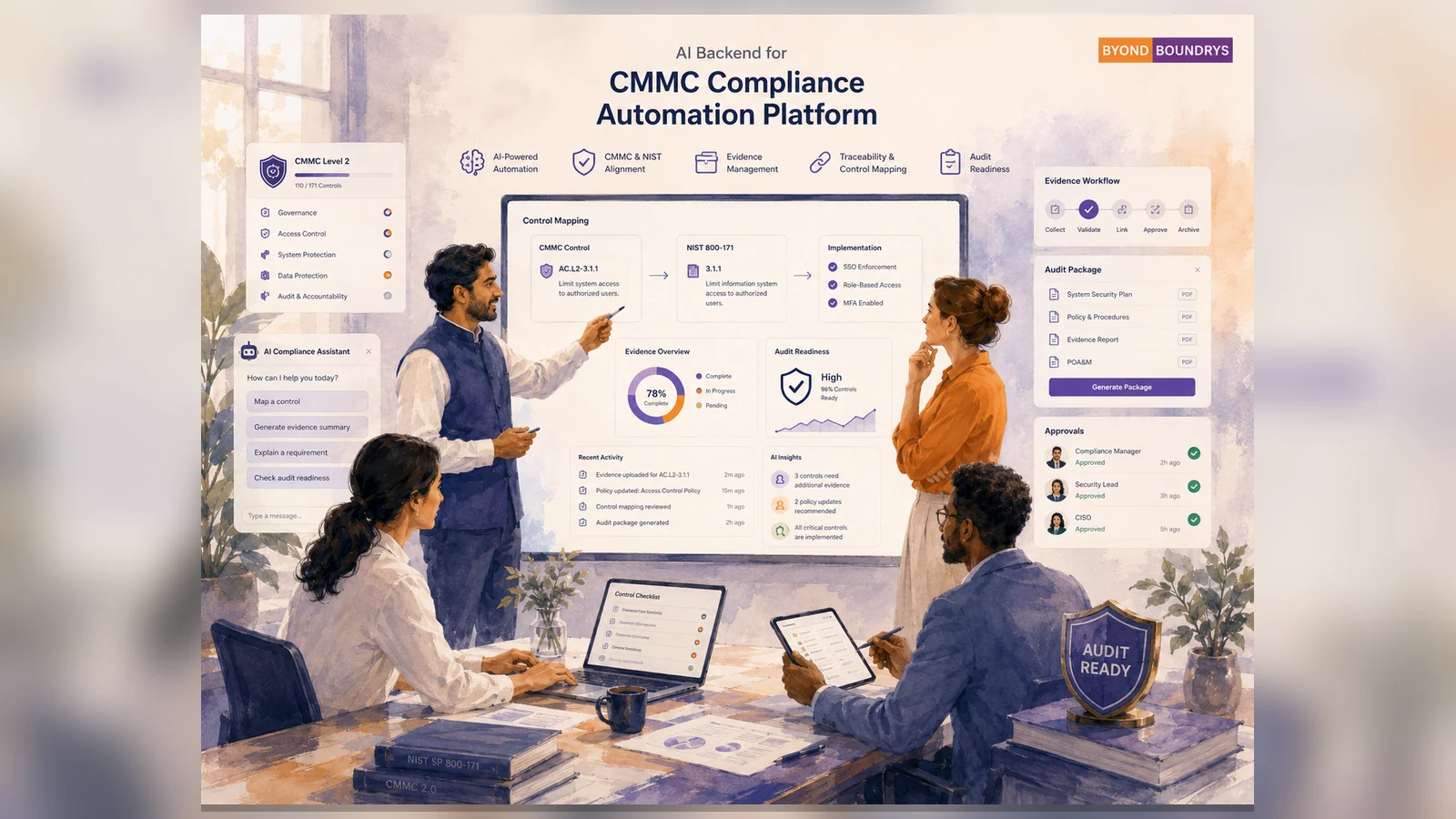
The backend maps requests to relevant CMMC and NIST controls before retrieving evidence and generating a response.
Generated guidance retains standards references so compliance professionals can review the basis of each answer.
Specialised services assess gaps, policies, procedures and evidence against control specific requirements.
01 / Business context
A US based compliance technology company building a CMMC exclusive documentation platform engaged Byond Boundrys to architect and build the AI backend that powers their workflow. The platform itself serves defense contractors, Managed Service Providers (MSPs/MSSPs), and CMMC consultants who need to prepare audit ready documentation aligned to CMMC and NIST 800-171. Our scope was strictly the AI/ML layer, an agentic AI compliance chatbot, the NIST focused reasoning engine, the agentic RAG system, gap assessment intelligence, document verification AI, and auto- generation engines for System Security Plans (SSP), Plans of Action and Milestones (POA&M), and Shared Responsibility Matrix (SRM) artifacts. The client owned the product, frontend application, customer experience, and go to market; we delivered the AI services that make the platform work.
02 / Challenge
The backend had to support formal CMMC assessment workflows with control level precision, auditability and privacy boundaries.
03 / Workflow transformation
04 / Solution
A LangGraph based multi agent service layer decomposed requests into intent detection, control mapping, grounded retrieval, compliance evaluation and structured output generation.
Classify each request as gap assessment, document verification, artefact generation or remediation guidance.
Link the request and supplied evidence to relevant CMMC and NIST 800-171 controls and objectives.
Chunk standards and uploaded documentation at control boundaries, embed the content and retrieve objective level evidence.
Evaluate posture across CMMC Level 2 objectives and return prioritised, NIST cited remediation guidance.
Verify policies, procedures and evidence against specific objectives and return actionable quality feedback.
Produce structured SSP, POA&M and SRM outputs from validated evidence and control mappings.
05 / Example workflow
06 / Delivery scope
Byond Boundrys delivered only the AI backend and APIs. The client retained ownership of the frontend, product experience and go to market. Quantitative impact figures are excluded from the public page.
07 / Architecture and controls
Queries are mapped to CMMC and NIST controls before retrieval and response generation.
Compliance guidance and generated artefacts follow controlled schemas and retain standards references.
The AI layer does not connect to client networks and does not persist CUI beyond the request lifecycle.
Clean APIs separate the AI backend from the client owned frontend and product experience.
08 / Business value
The backend maps requests to relevant CMMC and NIST controls before retrieving evidence and generating a response.
Generated guidance retains standards references so compliance professionals can review the basis of each answer.
Specialised services assess gaps, policies, procedures and evidence against control specific requirements.
The API layer produces structured compliance artefacts from validated mappings, evidence and remediation inputs.
The AI layer is separated from client networks and does not persist CUI beyond the request lifecycle described in the source.
Modular services and clean APIs support future NIST based frameworks after appropriate domain adaptation.
09 / Technology
Technology choices from the supplied project brief, mapped to the workflow each component supports.
Backend runtime and API layer exposing AI services to the client product

Reasoning, evaluation and structured compliance document generation

Stateful orchestration of specialised compliance agents

RAG and LLM application orchestration

Control level semantic vector retrieval
Embeddings for standards, controls and uploaded documentation, verify current production model
Secure production deployment foundation, including Azure Government where applicable

Parsing, boundary aware chunking and normalisation of standards and evidence
Related work


ON-SITE AI DISCOVERY
We come to your location for a full-day operational audit, then provide a prioritised AI Roadmap within 48 hours.