
Reduced repetitive policy-review effort
The proof of concept reduces repetitive document search and initial clause cross-checking.
Confidential AI proof of concept
RAG-based policy review, real-time knowledge retrieval and automated policy-gap analysis.
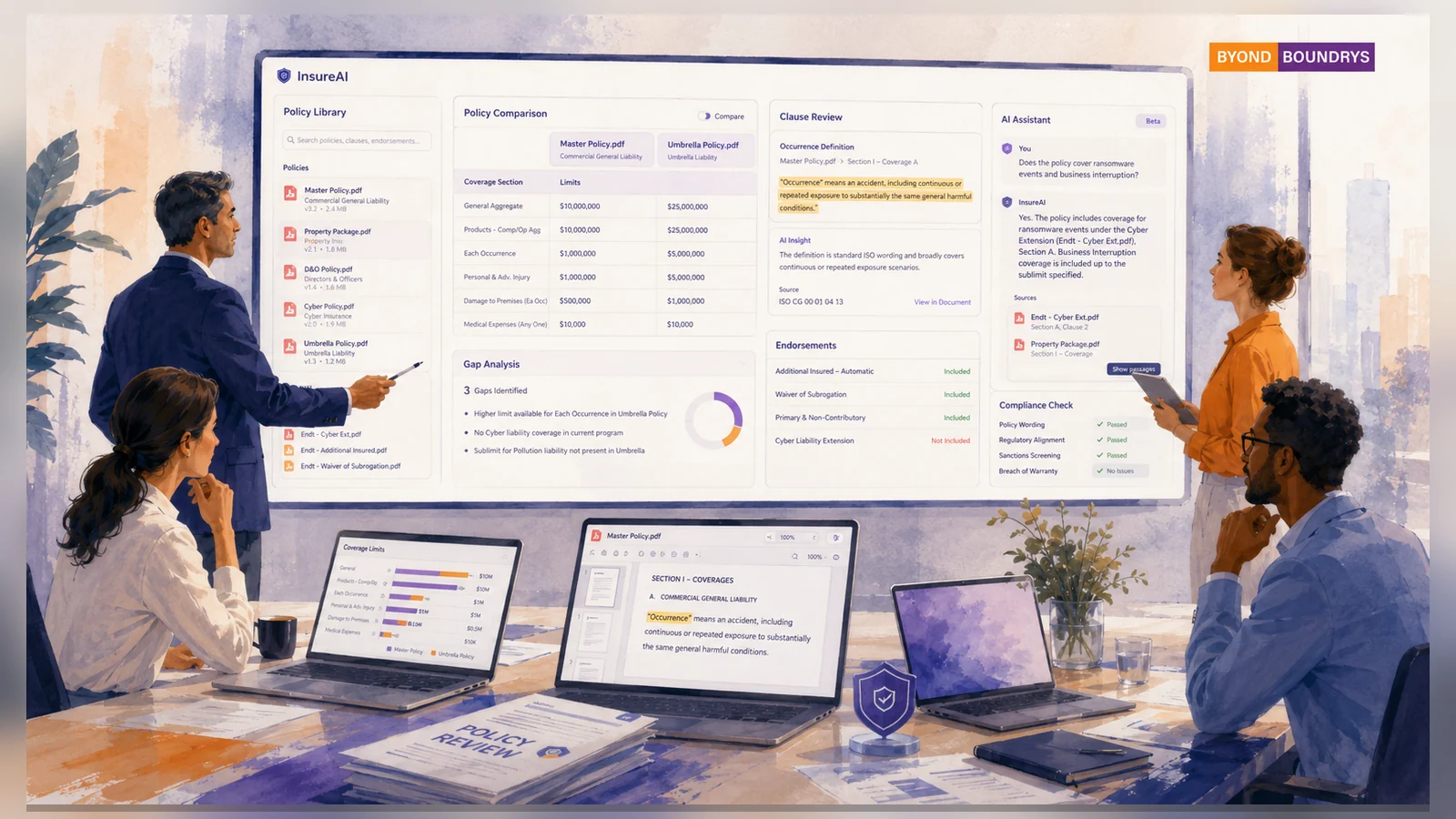
InsureAI was developed as a POC for an insurance consulting firm that needed to accelerate policy review, clause comparison, and compliance analysis across complex insurance documents. The consulting team worked with large volumes of insurance policies, internal knowledge-base documents, standard templates, compliance references, and client-submitted PDFs.
Project classification: This proof of concept was developed for a confidential insurance consulting firm.
The proof of concept reduces repetitive document search and initial clause cross-checking.
Semantic retrieval provides faster access to approved policy, template and standards content.
Policy comparison applies the same selected organisational standards across each review.
01 / Business context
InsureAI was developed as a POC for an insurance consulting firm that needed to accelerate policy review, clause comparison, and compliance analysis across complex insurance documents. The consulting team worked with large volumes of insurance policies, internal knowledge-base documents, standard templates, compliance references, and client-submitted PDFs. Reviewing these documents manually required significant time, domain expertise, and careful attention to policy wording, exclusions, limits, endorsements, and coverage differences. The client needed an AI-powered system that could ingest organizational knowledge documents and user-supplied insurance policies, retrieve relevant context in real time, answer policy-related questions, and identify gaps between uploaded policies and standardized internal knowledge.
02 / Challenge
The main challenge was that insurance policy review was highly manual, document-heavy, and time-consuming.
03 / Workflow transformation
04 / Solution
We designed InsureAI as a Retrieval-Augmented Generation based insurance intelligence platform for policy review and gap analysis. The solution combined document ingestion, PDF processing, semantic chunking, vector embeddings, similarity search, AI-powered Q&A, source attribution, and automated policy gap detection.
Load policies, standards, templates and reference documents into one knowledge layer.
Segment documents and create semantic retrieval indexes.
Return source-linked responses from the approved knowledge base.
Check uploaded policies against internal standards and flag differences or missing clauses.
05 / Example workflow
06 / Delivery scope
The work was a proof of concept. Final policy, legal and compliance judgement remains with qualified reviewers, and no quantified time-saving claim is made.
07 / Architecture and controls
Knowledge answers retain source references from approved policy and standards documents.
Gap indicators support qualified reviewers; they do not make final legal, coverage or compliance decisions.
Uploaded policies are compared with selected organisational standards and templates.
Client and policy information remains anonymised in the public case study.
08 / Business value
The proof of concept reduces repetitive document search and initial clause cross-checking.
Semantic retrieval provides faster access to approved policy, template and standards content.
Policy comparison applies the same selected organisational standards across each review.
Gap analysis surfaces missing clauses, exclusions, limits, endorsements and wording differences for expert review.
Source-linked answers give reviewers a traceable basis for follow-up and approval.
09 / Technology
Technology choices from the supplied project brief, mapped to the workflow each component supports.

RAG and LLM application orchestration
Reviewer or product user interface
AI, data-processing and backend logic

Backend APIs and workflow orchestration

Document and application data storage
Containerised deployment
Reverse proxy and production serving

Typed application engineering

Document parsing, chunking and normalisation
Related work



AI DISCOVERY ENGAGEMENT
One focused engagement to assess your business workflows, compare 5–7 candidate opportunities and recommend the first workflow worth funding.