
Faster conversion of statements into structured data
The proof of concept converts bank statement PDFs into structured transactions and balances for review.
Confidential AI proof of concept
Multi tenant bank statement analysis, financial Q&A and visual intelligence for finance teams.
FinSight AI was developed as a POC for a CA and finance advisory team that needed a faster, more affordable, and more intelligent way to analyze bank statements and extract financial insights. The team worked with bank statements from individuals, small businesses, and clients across different formats and banking layouts.
Project classification: This proof of concept was developed for a CA and financial advisory team.
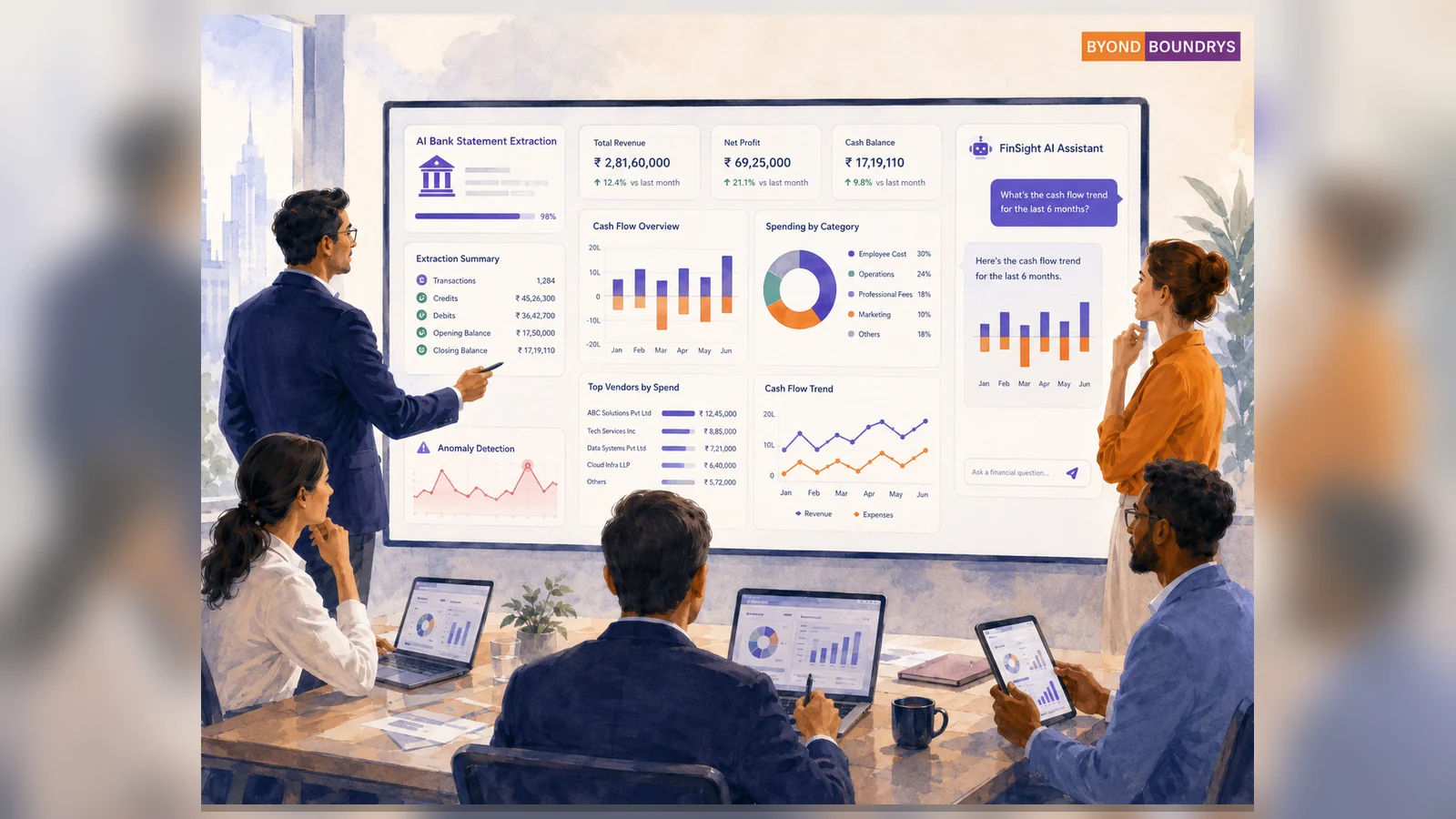
The proof of concept converts bank statement PDFs into structured transactions and balances for review.
Source metadata supports traceable search and question answering across extracted transactions.
Classification and dashboards surface UPI, cash flow, channel and spending patterns.
01 / Business context
FinSight AI was developed as a POC for a CA and finance advisory team that needed a faster, more affordable, and more intelligent way to analyze bank statements and extract financial insights. The team worked with bank statements from individuals, small businesses, and clients across different formats and banking layouts. These statements contained transaction data, account details, payment channels, narration fields, balances, UPI transactions, debit/credit flows, and statement periods. Existing workflows were not fully manual, but they still involved significant effort.
02 / Challenge
The main challenge was that bank statement analysis was still time consuming, fragmented, and difficult for non technical finance users.
03 / Workflow transformation
04 / Solution
We designed FinSight AI as a multi tenant financial intelligence platform combining document extraction, transaction intelligence, vector search, RAG based Q&A, metadata enrichment, and real time analytics dashboards. The solution converted bank statement PDFs into structured, searchable, and analyzable financial data.
Extract transactions, balances, dates and source metadata from bank PDFs.
Handle multi format dates and classify income, expenses and payment channels.
Calculate KPIs and present trends through a multi tenant dashboard.
Index structured data and answer questions through retrieval augmented generation.
05 / Example workflow
06 / Delivery scope
The work was a proof of concept. Production scale accuracy, time savings and financial decision impact were outside the validated scope.
07 / Architecture and controls
Extracted transactions retain statement and metadata context for review.
Dates, balances, debit/credit fields and classifications are normalised before analytics and Q&A.
Dashboards and natural language answers support finance professionals and do not replace qualified judgement.
The architecture separates organisational data within the multi tenant proof of concept.
08 / Business value
The proof of concept converts bank statement PDFs into structured transactions and balances for review.
Source metadata supports traceable search and question answering across extracted transactions.
Classification and dashboards surface UPI, cash flow, channel and spending patterns.
Finance users can explore prepared dashboards without manually building spreadsheet charts for the initial review.
The multi tenant design demonstrates how the workflow could be extended across organisations.
09 / Technology
Technology choices from the supplied project brief, mapped to the workflow each component supports.

RAG and LLM application orchestration

Reviewer or product user interface

AI, data processing and backend logic

Backend APIs and workflow orchestration

Vector retrieval and semantic search
Document and application data storage

Containerised deployment

Typed application engineering
Analytics dashboard visualisation

Document parsing, chunking and normalisation
Related work


ON-SITE AI DISCOVERY
We come to your location for a full-day operational audit, then provide a prioritised AI Roadmap within 48 hours.