
Faster job description and posting workflows
AI assisted job description tools reduce repetitive drafting before recruiter review.
Internal product case study
AI assisted job posting, candidate management, screening and recruiter operations.
Simplify Job Search was developed as a two sided job search and hiring platform that supports both candidates and recruiters. This case study focuses on the recruitment side platform, which helps HR teams, companies, freelancer recruiters, and hiring managers manage hiring workflows from one structured system.
Project classification: This internal Byond Boundrys product module is part of the Simplify Job Search platform.
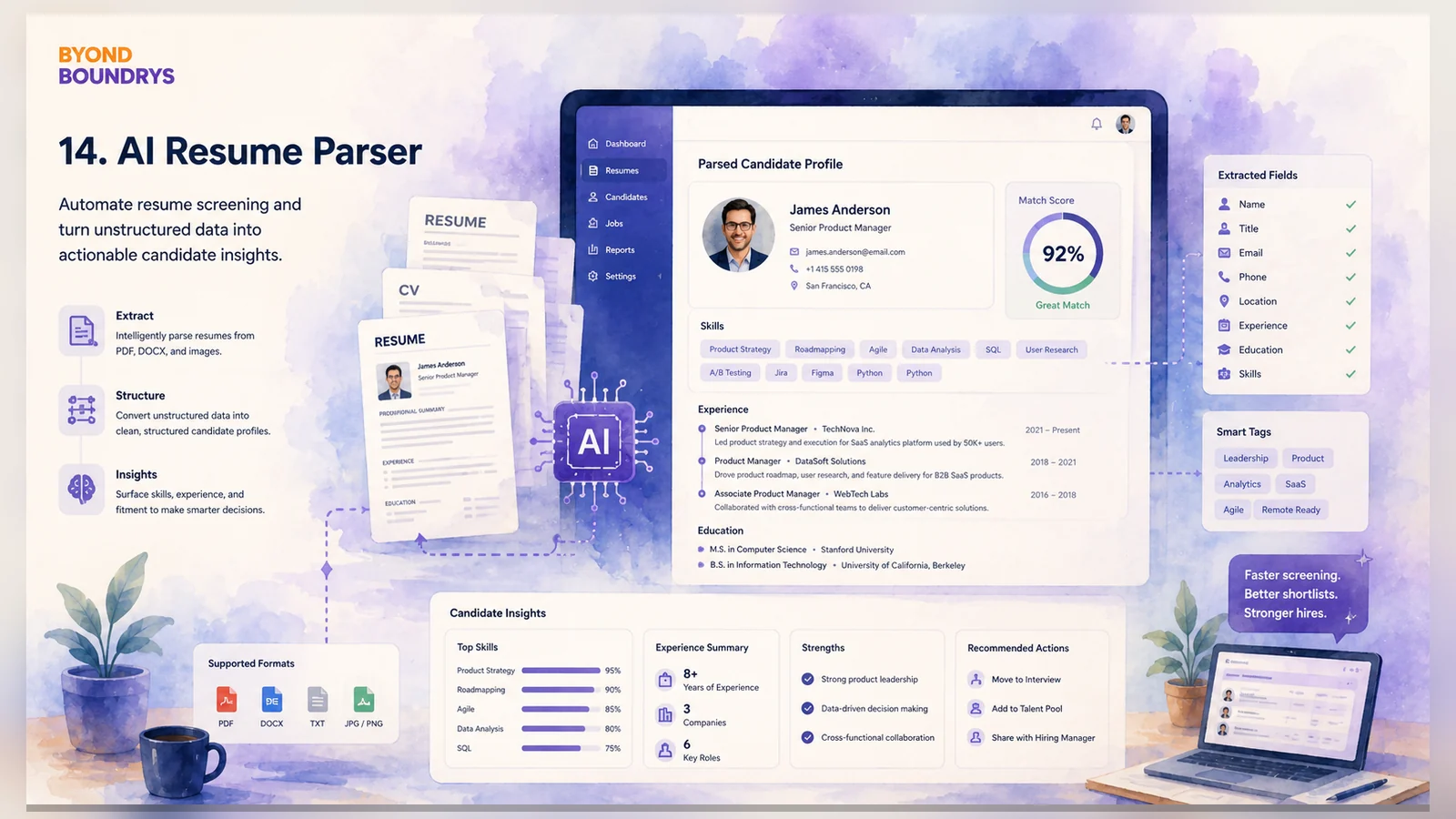
AI assisted job description tools reduce repetitive drafting before recruiter review.
Jobs, applicants and recruiter actions are managed within one hiring workspace.
Candidate status stages create a consistent view of progress across the hiring process.
01 / Business context
Simplify Job Search was developed as a two sided job search and hiring platform that supports both candidates and recruiters. This case study focuses on the recruitment side platform, which helps HR teams, companies, freelancer recruiters, and hiring managers manage hiring workflows from one structured system. The recruitment side module was created to reduce the operational friction involved in posting jobs, writing job descriptions, collecting candidate applications, screening applicants, tracking candidate status, inviting candidates by email, and importing resumes in bulk. Recruiters can sign up, log in, manage their dashboard, create job posts, publish jobs, manage company/client information, add screening questions, view applicants, update candidate status, send bulk job invites through CSV uploads, and upload ZIP files containing multiple resumes for recruiter side candidate ingestion.
02 / Challenge
Recruitment teams often manage hiring through fragmented tools, manual spreadsheets, email threads, shared documents, and disconnected job boards.
03 / Workflow transformation
04 / Solution
Simplify Job Search was designed as an AI assisted recruitment workflow platform where AI is used to reduce repetitive work and automation is used to make hiring operations more structured. The recruitment side approach combines recruiter authentication, job creation, AI assisted job description generation, screening question workflows, candidate application tracking, bulk CSV email invites, ZIP based resume ingestion, candidate status management, recruiter dashboards, client management, email automation, and cloud based storage.
Support recruiter roles, profiles and company or client ownership.
Use structured forms and AI assistance for job description preparation.
Track applications, screening questions, notes and pipeline movement.
Send targeted or bulk candidate messages through scalable email workflows.
05 / Example workflow
06 / Delivery scope
The page covers current recruiter workflows. Planned adaptive screening, proctoring and future modules are outside this case study scope.
07 / Architecture and controls
Recruiter, client and hiring workspace permissions separate operational responsibilities.
Recruiters must have a valid basis for uploading, contacting and managing candidate information.
AI assisted job content and workflow support do not replace recruiter review or approval.
SES and queue based delivery support traceable communication, retry and operational monitoring.
08 / Business value
AI assisted job description tools reduce repetitive drafting before recruiter review.
Jobs, applicants and recruiter actions are managed within one hiring workspace.
Candidate status stages create a consistent view of progress across the hiring process.
Email and outreach workflows support repeatable communication with selected candidates.
The platform supports both internal recruitment teams and recruiter client operating models.
09 / Technology
Technology choices from the supplied project brief, mapped to the workflow each component supports.

Structured extraction, reasoning or generation

Managed LLM inference and reasoning
Web application interface
Backend and integration services

Scalable application and workflow data

Cloud infrastructure and managed services

Containerised deployment
Reverse proxy and production serving

Managed Gemini and AI model integration

Transactional email and alert delivery
Related work


ON-SITE AI DISCOVERY
We come to your location for a full-day operational audit, then provide a prioritised AI Roadmap within 48 hours.