
Reduced source to standard mapping preparation effort
The prototype reduced the preparation required before experts reviewed source to standard mappings.
Confidential AI case study
Hybrid RAG and fine tuned small language models for explainable source to standard clinical data mapping.
A healthcare / clinical research organization needed to harmonize complex source datasets into a standardized data model for downstream analytics, reporting, and research workflows. The source data contained a large number of variables with inconsistent naming conventions, incomplete descriptions, mixed data types, missing value codes, and domain specific clinical meanings.
Project classification: This proof of concept was developed for a confidential healthcare and clinical research organisation.
The prototype reduced the preparation required before experts reviewed source to standard mappings.
It produced structured harmonisation plans that domain experts could inspect, correct and approve.
Hybrid semantic, keyword and metadata retrieval improved candidate selection when variable names did not match directly.
01 / Business context
A healthcare / clinical research organization needed to harmonize complex source datasets into a standardized data model for downstream analytics, reporting, and research workflows. The source data contained a large number of variables with inconsistent naming conventions, incomplete descriptions, mixed data types, missing value codes, and domain specific clinical meanings. Manual harmonization required significant domain expertise and was time consuming, especially when variables required mapping, renaming, transformation logic, category conversion, or new derived variable creation. To protect confidentiality, client name, dataset name, project name, and standard model details are not disclosed.
02 / Challenge
The organization wanted to reduce the manual effort involved in mapping raw clinical variables to a target standard. The main challenges were: • Source variables were often ambiguous or poorly documented. • Similar clinical concepts appeared with different names across datasets. • Some variables required direct mapping, while others required transformation logic. • Traditional keyword matching was not enough because clinical meaning depends on context. • LLM outputs needed control because they could over predict mappings or generate unnecessary transformations. • The solution needed to be generalized, not hardcoded for one dataset.
03 / Workflow transformation
04 / Solution
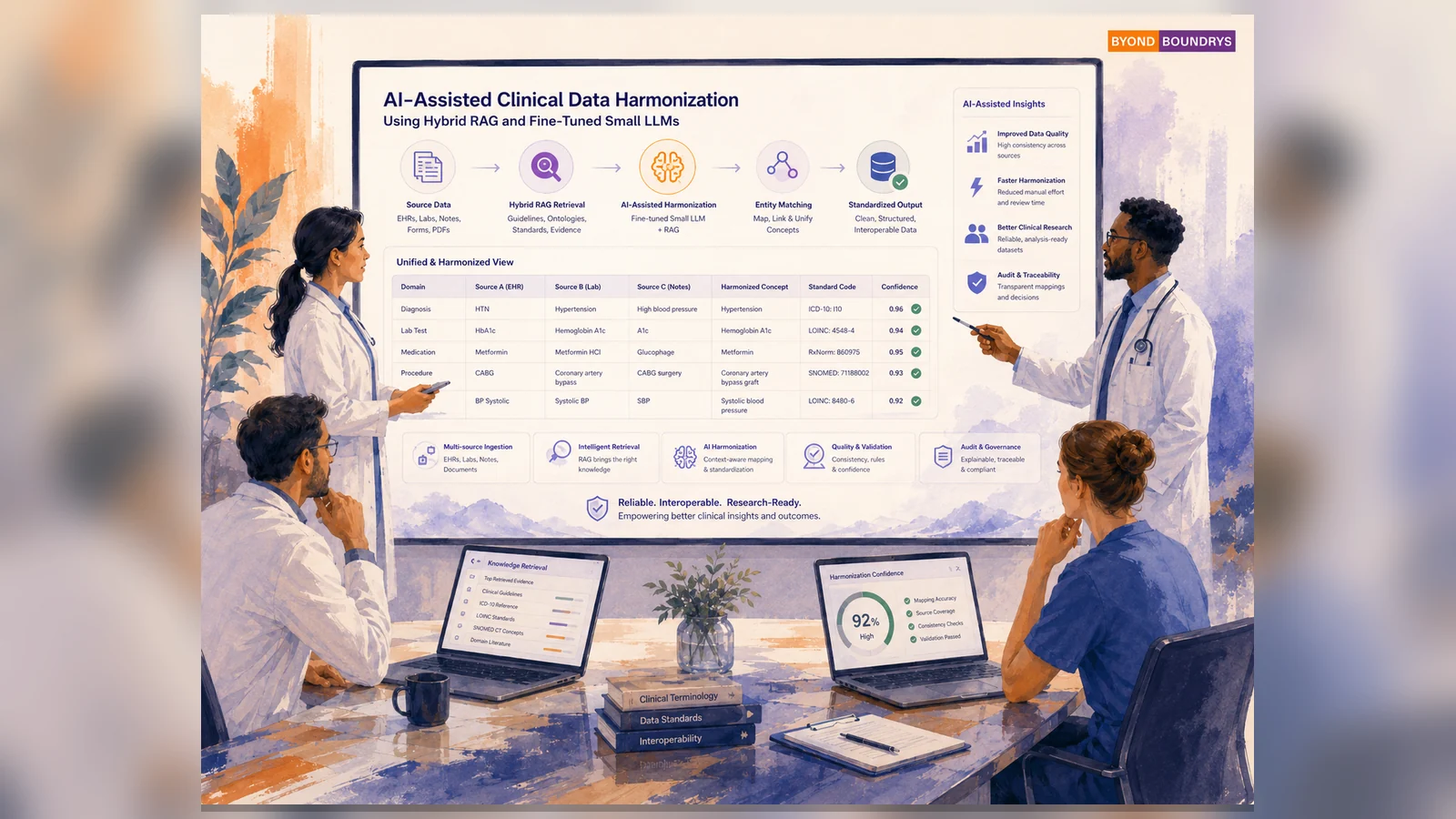
We designed an AI assisted harmonization workflow using hybrid RAG, metadata enrichment, and fine tuned small language models. Instead of relying on a single large model, the solution used multiple specialized small LLM components fine tuned for different parts of the workflow.
Profile names, descriptions, types and value patterns before retrieval.
Combine semantic, keyword, metadata and domain aware matching.
Use fine tuned small language models for mappings and transformations.
Apply schema checks, guardrails, confidence filters and repeatable evaluation.
05 / Example workflow
06 / Delivery scope
The work was limited to a proof of concept focused on retrieval, mapping and validation. Production integration, the final target standard and externally approved benchmark reporting were outside this public scope.
07 / Architecture and controls
Structured schemas, consistency checks and transformation rules reduce malformed or unnecessary operations.
Low confidence mappings remain visible for domain expert review rather than being silently accepted.
Candidate mappings retain the metadata and retrieved target context used to form the recommendation.
Client, dataset and target model details remain anonymised in the public case study.
08 / Business value
The prototype reduced the preparation required before experts reviewed source to standard mappings.
It produced structured harmonisation plans that domain experts could inspect, correct and approve.
Hybrid semantic, keyword and metadata retrieval improved candidate selection when variable names did not match directly.
Schema checks and guardrails reduced unsupported mappings and unnecessary transformation steps.
The workflow created a repeatable benchmark and batch evaluation process for further model iteration.
09 / Technology
Technology choices from the supplied project brief, mapped to the workflow each component supports.

AI, data processing and backend logic

Fast vector similarity retrieval

Keyword and exact term retrieval
Structured schema and output validation

Model training and inference

Tabular data processing and analysis

Parameter efficient model fine tuning
Numerical processing
Related work


ON-SITE AI DISCOVERY
We come to your location for a full-day operational audit, then provide a prioritised AI Roadmap within 48 hours.